
| 일 | 월 | 화 | 수 | 목 | 금 | 토 |
|---|---|---|---|---|---|---|
| 1 | 2 | 3 | 4 | 5 | 6 | |
| 7 | 8 | 9 | 10 | 11 | 12 | 13 |
| 14 | 15 | 16 | 17 | 18 | 19 | 20 |
| 21 | 22 | 23 | 24 | 25 | 26 | 27 |
| 28 | 29 | 30 | 31 |
- string
- 알고리즘
- array
- 포인터
- 파이썬
- baekjoon
- 반복문
- Class
- vscode
- Data Science
- pass by reference
- function
- 티스토리챌린지
- programming
- Deep Learning
- OOP
- raw data
- 백준
- 문자열
- C++
- pointer
- 오블완
- Pre-processing
- Python
- assignment operator
- Object Oriented Programming
- 배열
- const
- 함수
- predictive analysis
- Today
- Total
Channi Studies
[Data Structure] Heap Sort 본문
Heapify Operation
Heapsort is a sorting algorithm that takes advantage of a max-heap's properties by repeatedly removing the max and building a sorted array in reverse order. An array of unsorted values must first be converted into a heap. The heapify opeartion is used to turn an array into a heap. Since leaf nodes already satisfy the max heap property, heapifying to build a max-heap is achieved by percolating down on every non-leaf node in reverse order.
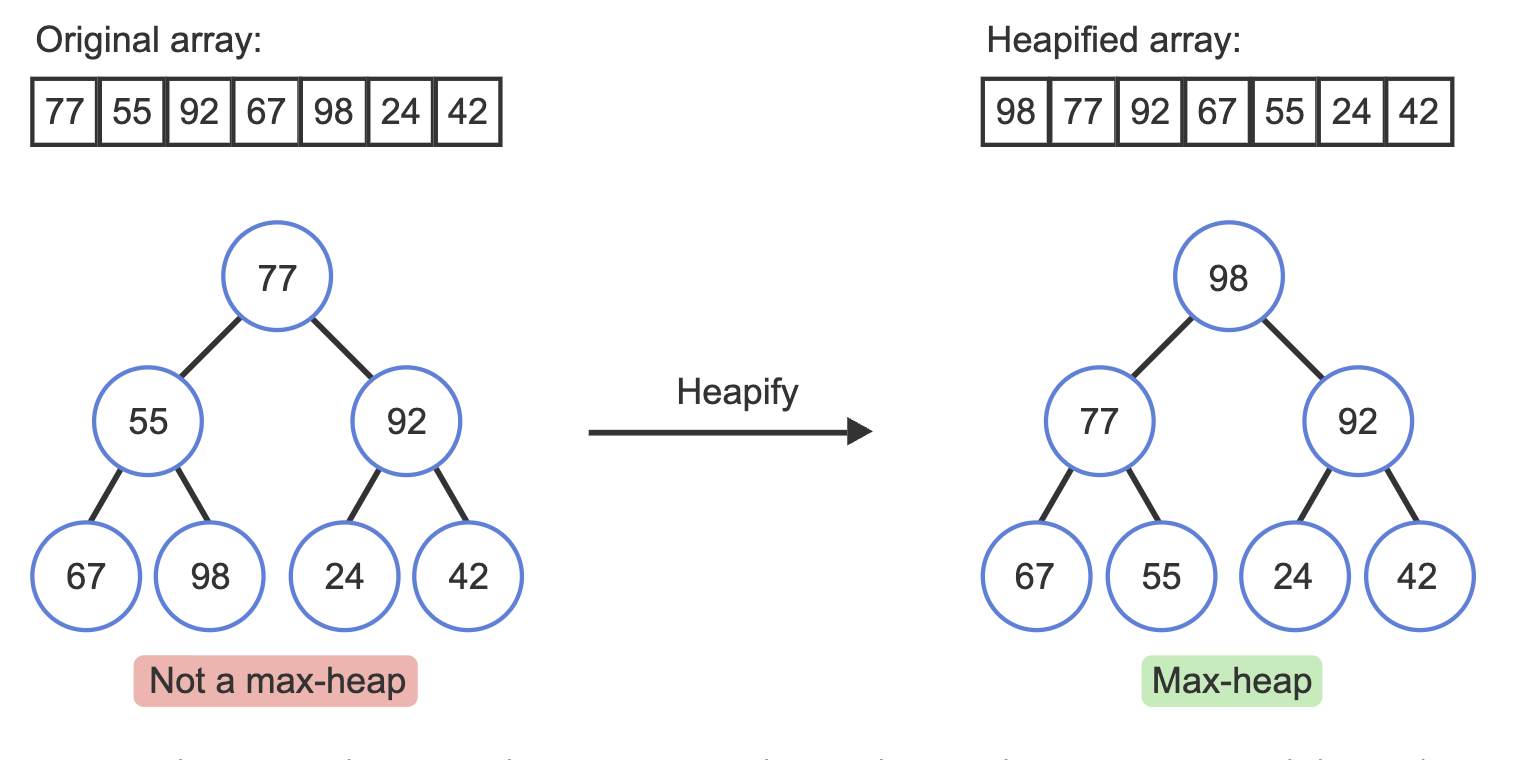
The heapify operation starts on the internal node with the largest index and continudes down to, and including, the root node at index 0.
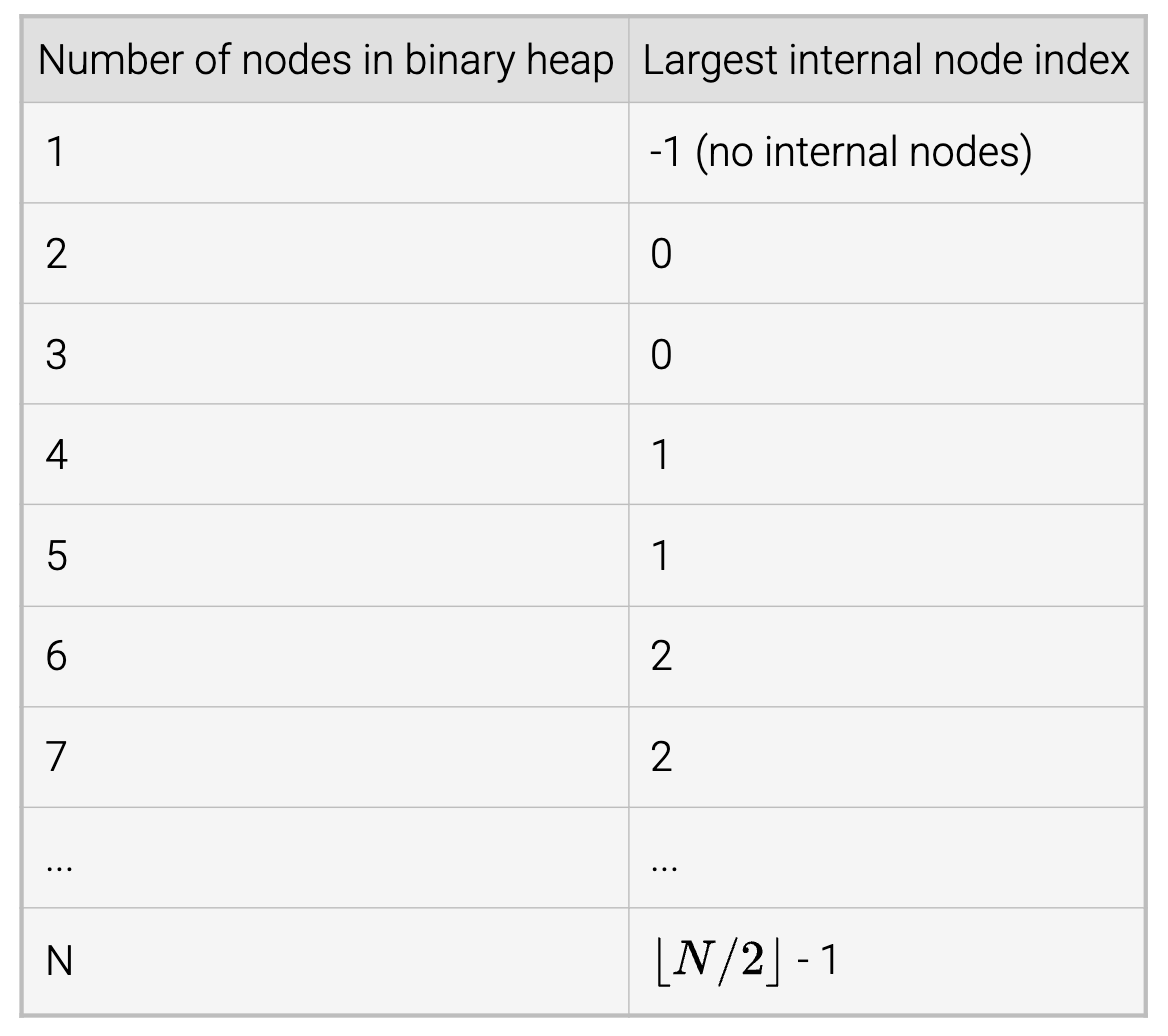
Given a binary tree with N nodes, the largest internal node index is ⌊N/2⌋ - 1.
Heap Sort
Heapsort uses 2 loops to sort an array. The first loop heapifies the array using MaxHeapPercolateDown. The second loop removes the maximum value, stores that value at the end index, and decrements the end index, until the end index is 0.
# Binary max heap percolate down
def max_heap_percolate_down(node_index, heap_list, list_size):
    child_index = 2 * node_index + 1
    value = heap_list[node_index]

    while child_index < list_size:
        # Find the max among the node and all the node's children
        max_value = value
        max_index = -1
        i = 0
        while i < 2 and i + child_index < list_size:
            if heap_list[i + child_index] > max_value:
                max_value = heap_list[i + child_index]
                max_index = i + child_index
            i = i + 1

        if max_value == value:
            return

        # Swap heap_list[node_index] and heap_list[max_index]
        temp = heap_list[node_index]
        heap_list[node_index] = heap_list[max_index]
        heap_list[max_index] = temp

        node_index = max_index
        child_index = 2 * node_index + 1


# Sorts the list of numbers using the heap sort algorithm
def heap_sort(numbers):
    # Heapify numbers list
    i = len(numbers) // 2 - 1
    while i >= 0:
        max_heap_percolate_down(i, numbers, len(numbers))
        i = i - 1

    i = len(numbers) - 1
    while i > 0:
        # Swap numbers[0] and numbers[i]
        temp = numbers[0]
        numbers[0] = numbers[i]
        numbers[i] = temp

        max_heap_percolate_down(0, numbers, i)
i = i - 1'Data Science > Data Structure & Algorithm' 카테고리의 다른 글
| [ADT] Priority Queue Abstract Data Type (0) | 2025.05.09 |
|---|---|
| Abstract Data Type (ADT) V.S. Data Structure | 추상 자료형 vs 자료 구조형 (0) | 2025.05.09 |
| [Data Structure] Heaps Python Implementation (0) | 2025.05.08 |
| [Data Structure] Heaps - 2 | Heaps Using Arrays (0) | 2025.05.08 |
| [Data Structure] Heaps - 1 | Max-heap (최대 힙) and Min-heap (최소 힙) (0) | 2025.05.08 |


