
| 일 | 월 | 화 | 수 | 목 | 금 | 토 |
|---|---|---|---|---|---|---|
| 1 | ||||||
| 2 | 3 | 4 | 5 | 6 | 7 | 8 |
| 9 | 10 | 11 | 12 | 13 | 14 | 15 |
| 16 | 17 | 18 | 19 | 20 | 21 | 22 |
| 23 | 24 | 25 | 26 | 27 | 28 | 29 |
| 30 | 31 |
- 반복문
- 티스토리챌린지
- 포인터
- pointer
- 함수
- pass by reference
- Data Science
- Python
- function
- array
- 알고리즘
- string
- programming
- Deep Learning
- Pre-processing
- C++
- 오블완
- baekjoon
- 백준
- Class
- 배열
- 문자열
- OOP
- 파이썬
- predictive analysis
- assignment operator
- const
- Object Oriented Programming
- raw data
- vscode
- Today
- Total
Channi Studies
[Sorting] Insertion Sort 본문
In the final post, we have studied about the selection sort and its implementation in Python.
https://code-studies.tistory.com/123
[Sorting] Introduction & Selection Sort
Sorting Sorting is the process of converting a list of elements into ascending (or descending) order.You may remember the importance of sorting in binary search from my previous post. In the following few posts, we will be studying about the types of so
code-studies.tistory.com
In this post, we will study about the second sorting algorithm, insertion sort.
Insertion Sort
Insertion sort is a sorting algorithm that treats the input as two parts, a sorted part and an unsorted part, and repeatedly inserts the next value from the unsorted part into the correct location in the sorted part.
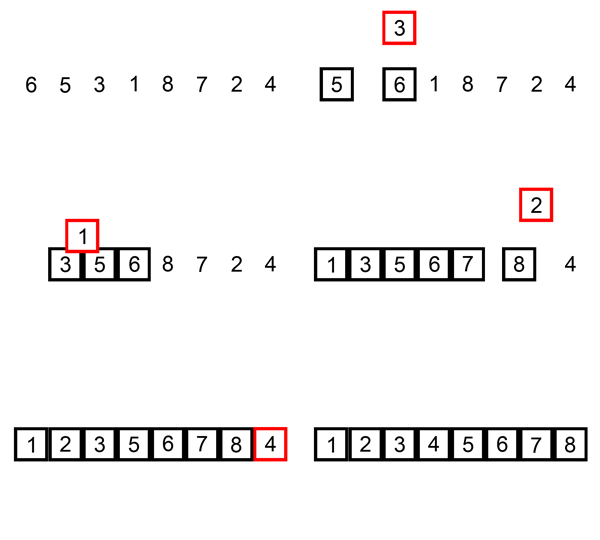
It is much easier to understand following the flow of the code.
Let's look into Python function implementation of insertion sort.
Python Implementation
def insertion_sort(arr: list[int]) -> None:
    for i in range(1, len(arr)):
        j = i

        while (j > 0) and (arr[j-1] > arr[j]):
            arr[j-1], arr[j] = arr[j], arr[j-1]
            j -= 1
Starting from the second index position i = 1, i traverse through all of the index.
i denotes the starting position of the current element in the unsorted part.
The inner loop repeatedly swaps elements if the left element has higher value, to put current element in the right position of sorted part.
After slowly following the path of the code, you can quickly grasp the concept of insertion sort.
Runtime Complexity
To get straight to the point, typical runtime of insertion sort is O(N²).
If a list has N terms, the outer loop will execute N - 1 times (because it starts from i = 1).
For each outer loop execution, the inner loop has on average N/2 executions.
So the total number of comparisons is proportional to N(N - 1)/2, or O(N²).
Nearly Sorted Lists
For sorted or nearly sorted lists, runtime complexity of insertion sort is O(N).
A nearly sorted list only contains a few elements not in sorted order.
Ex: (4, 5, 17, 25, 89, 14) is nearly sorted having only one element not in sorted position.
In a nearly sorted list with total N elements, say there are constant C number of unsorted elements, giving N - C sorted elements.
Each outer loop will require at most N comparisons for the unsroted elements, and constant 1 comparison for the sorted elements.
Thus, the runtime complexity sums up to be:
O(C * N + (N - C) * 1) = O(N²)
In the following post, we will delve into shell sort.
'Data Science > Data Structure & Algorithm' 카테고리의 다른 글
| [Sorting] Quick Sort (0) | 2025.03.17 |
|---|---|
| [Sorting] Shell Sort (0) | 2025.03.17 |
| [Sorting] Introduction & Selection Sort (0) | 2025.03.16 |
| [Algorithm] Big-O Notation | 빅 오 표기법 (0) | 2025.03.12 |
| [Algorithm] Growth of Functions and Complexity (0) | 2025.03.12 |


